When a late part meant a stopped line
Thirty years ago, when a critical part was running late, we found out the hard way. The line stopped, the phones started ringing, and a planner spent the day chasing a truck nobody could locate.
have lived that day more times than I care to count. The supplier said the truck had left. The transporter said it was on the way. Meanwhile production, sales and finance all wanted one answer: when?
Nobody was careless. We simply could not see. Information travelled slower than the material itself, and by the time we knew about a problem, it had already become a crisis.
The same breakdown, today
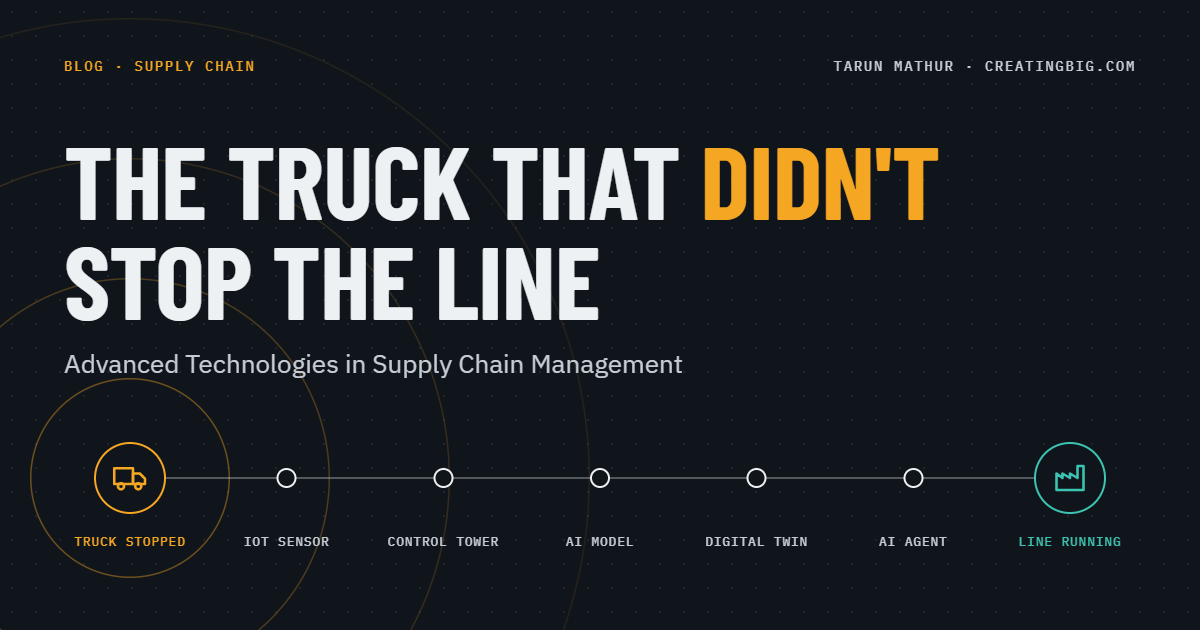
Picture the same situation today. A truck carrying a critical component breaks down on the highway, four hours from the plant.
A sensor on the vehicle reports the stoppage within minutes. This is the Internet of Things at its most practical: a truck that tells you where it is, and that it is no longer moving.
Before anyone picks up a phone, the control tower has connected that truck to everything depending on it. It shows which production orders are at risk, in which plants, and which customer deliveries sit behind them.
Then artificial intelligence takes over the arithmetic. A model trained on years of demand and supply patterns recalculates what is truly urgent and what can wait a shift.
A digital twin, a virtual copy of the entire network, tests the options in minutes. Pull stock from another warehouse. Re-sequence the line. Expedite from a second supplier. Each choice arrives with its cost and its consequence.
An AI agent then does the legwork. It reschedules the delivery, raises the purchase order, and sends the dealer a revised date. In the warehouse, autonomous mobile robots are already repositioning material for the new sequence.
From chasing to choosing
The planner's job has changed. There is no chasing left to do, only one decision: approve the best option.
That is what advanced technology really means in supply chain management. Not gadgets, but hours of firefighting compressed into minutes of informed decision-making.
It also changes what we value in people. Yesterday's hero was the planner who could find a truck at midnight. Tomorrow's hero is the one who can question a recommendation, weigh its trade-offs, and own the call.
What technology cannot fix
Three decades have taught me one thing that has not changed. None of this works on a weak foundation.
If the master data is wrong, the algorithm is confidently wrong. A lead time that was never updated, or a bill of materials with errors, will mislead the smartest model you can buy.
If planning discipline is missing, the dashboard only shows the chaos in higher resolution. And if people do not trust the numbers, they quietly return to their spreadsheets and phone calls.
The tools are the easy part. The foundation is the hard part.
Where to begin
My advice to any organisation starting this journey is to resist the urge to buy everything at once. Pick one problem that hurts every week, such as inbound visibility or forecast accuracy, and fix the data behind it first.
Then let the technology prove itself on that single problem. A small success that people trust will carry further than a large platform nobody believes.
Advanced technologies will not replace supply chain professionals. They will free us from the chase, and ask for better judgement in return.
Where is your supply chain on this journey? I would be glad to hear your experience in the comments.